
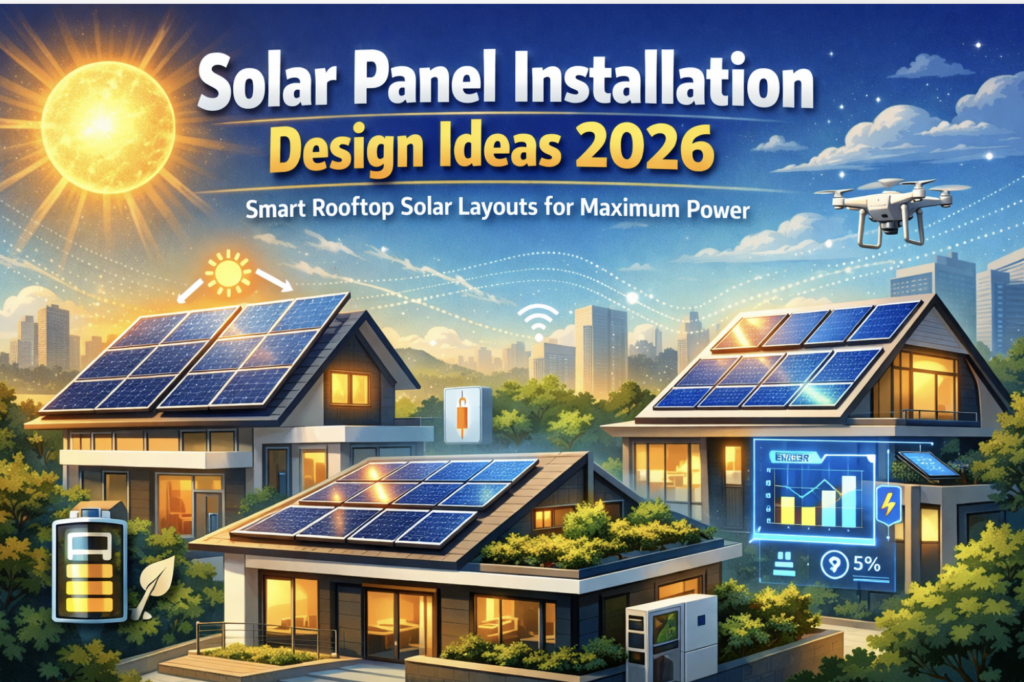
The rate at which people are installing solar panels on their home roofs has increased significantly, and in 2026 the debate has moved beyond merely adding panels. Homeowners seek installations that do not just generate power. They desire designs that make good use of roof space, are more efficient, and are aesthetically compatible with today’s house designs. Smart solar panel installation design ideas are important indeed.
Even with the same number of panels, a good layout can generate a lot more electricity than a bad layout. The proper installation will position panels correctly, avoid shadows, allow air to circulate around them, and keep the roof secure. Conversely, poorly considered arrangements are seen to generate less output and waste more of the available energy.
With solar tech improving all the time, current solar installation design ideas blend careful engineering with good looks. More homeowners pick arrangements that deliver strong results while keeping the roof looking neat and tidy.
In this guide, we cover the best solar panel design ideas for 2026. That covers new roof designs, updated system configurations, and strategies that help homeowners generate additional energy and keep their solar system in working condition over the coming years.
Why Solar Panel Installation Design Matters More Than Ever
Solar setups keep running for over twenty years, so any planning errors at installation time hurt power output for a long time. The right approach ensures panels capture as much sunlight as possible every day.
Current solar installation design ideas target three main goals:
- Maximizing electricity generation
- Improving system durability
- Maintaining rooftop aesthetics
- Making cleaning easier
A solid layout gives the best gaps between panels, the proper tilt, and almost no shade. That brings better efficiency and a stronger payback.
Solar Panel Installation Design Ideas for 2026
The solar field keeps coming up with better ways to install panels. Here are the top solar panel design ideas homeowners are choosing in 2026.
1. South-Facing Solar Panel Layout
For any home in Delhi, Ghaziabad, Noida, Faridabad, or Gurgaon, a south-facing layout is the single strongest design decision you can make.
In the northern hemisphere, the sun arcs from east to west across the southern sky. Panels facing true south capture this arc from morning to evening, giving consistent, full-day generation.
Key numbers:
1. Ideal tilt angle for Delhi NCR: 25–28°
2. Annual output advantage over flat panels: 15–20% more units
3. Works best with: aluminum tilt frames on flat roofs
When to choose this: Your roof has clear south-facing space without shadows from water tanks, staircases, or neighboring buildings.
Internal tip: If you are sizing for the PM Surya Ghar Yojana subsidy, fill your south-facing rows first up to the 3 kW threshold before expanding in other directions.
2. East-West Panel Installation Design
Not every Delhi NCR roof has open southern exposure. Builder floors, corner plots, and homes near tall buildings often have shadows falling exactly where south-facing panels would go.
The east-west split solves this by dividing your array into two groups:
- East-facing panels generate from 7 am to noon
- West-facing panels generate from noon to 6 pm
This spreads production more evenly across the day and reduces peak inverter stress, important if your household consumption is spread across morning and evening.
Key numbers:
- Production advantage over flat panels: 8–12% more annually
- Better self-consumption match for households that use power morning and evening
- Works well with string inverters, microinverters
When to choose this: South-facing space is blocked or limited, or your electricity usage peaks both morning and evening. 85%.
3. Elevated Solar Panel Structures
Standard flush mounts leave a 2–4-inch air gap under the panels. Elevated mounts raise this to 8–12 inches. In Delhi’s summers, where rooftop temperatures routinely cross 55–60°C, this difference matters significantly.
Solar panels lose roughly 0.3–0.4% efficiency per °C above 25°C. An elevated mount that keeps panels 8–12°C cooler than a flush mount recovers 3–5% in annual output at no additional panel cost.
Additional benefits specific to Delhi NCR:
- Easier cleaning access underneath rows
- Better drainage during monsoon (prevents pooling)
- Reduced dust accumulation on panel surfaces
When to choose this: Any flat-roof installation in Delhi NCR. We recommend elevated mounts as the default for all our installations; see how we applied this in our 7 kW Faridabad case study, where the homeowner reduced their bills by 85%
4. Integrated Solar Panel Layouts
Integrated plans match panel positions to the roof’s own shape.
Panels line up evenly to match up cleanly with:
- Roof edges
- Staircase structures
- Water tanks
This method keeps solar panel design ideas balanced between good looks and strong results.
5. Shadow-Optimized Panel Placement
Shade creates one of the largest problems for solar setups. Up-to-date solar installation design ideas study how shadows move during daylight hours.
Design strategies include:
- Avoiding shadow-prone areas
- Adjusting panel spacing
- Repositioning panels around rooftop structures
Shadow planning makes sure panels stay in full sun without breaks. Use our savings calculator to estimate how much a shadow-free layout would save you versus a partially shaded one.
6. Compact High-Efficiency Panel Layouts
Newer panels achieve higher efficiency than older ones. That lets installers use tighter solar panel layouts to generate more power from fewer panels.
Advantages include:
- Less rooftop space required
- Improved system efficiency
- Clean and organized layout
High-efficiency panels advance this approach, especially in city houses.
7. Smart Monitoring-Friendly Designs
By 2026 solar setups link up more often with tracking tools.
Current solar panel installation design ideas place inverters and run wiring so they connect easily to monitoring equipment.
This lets homeowners check:
- Real-time electricity generation
- System performance trends
- Energy savings over time
Smart tracking makes the system clearer and easier to keep at peak level.
8. Future-Expandable Solar Layouts
Homeowners who think ahead build solar setups ready for growth later on.
Expandable solar panel design ideas save space, allowing more panels to be added as power demand increases.
This helps a lot when people expect to bring in:
- Electric vehicles
- Additional appliances
- Home expansions
A design built for tomorrow safeguards the whole solar choice.
How Does Proper Design Improve Solar Performance?
Good planning significantly improves how well a solar system works.
Carefully thought-out solar panel design ideas raise energy output through:
- Optimizing sunlight exposure
- Reducing shading losses
- Improving airflow and cooling
- Ensuring proper panel spacing
Those planning choices improve overall efficiency and reduce payback time.
Common Solar Design Mistakes to Avoid
As people look at solar installation design ideas, they need to know typical errors too.
These include:
- Random panel placement
- Ignoring shadow patterns
- Incorrect tilt angles
- Poor wiring management
Steering clear of those problems keeps solar setups running well for many years.
Role of Professional Solar Design
Solar system planning calls for real skill. Experienced installers inspect the roof closely before settling on a layout.
A clear planning process normally covers:
- Rooftop inspection
- Shadow analysis
- Structural assessment
- System layout planning
Expert planning guarantees the picked solar panel design ideas deliver what they promise.
Solar Design Trends Expected in 2026
A few directions look set to lead solar work in 2026:
- High-efficiency panel layouts
- Elevated mounting structures
- Aesthetic rooftop integration
- Smart monitoring systems
- Expandable solar systems
These changes show how the field is moving toward sharper, stronger solar setups.
Benefits of Smart Solar Panel Installation Designs
How well a solar system works depends mostly on its design. The same panels and inverter on two different roofs can give very different results based on how they are arranged. That explains why up-to-date solar installation design ideas place a strong focus on smart positioning, proper spacing, and solid structure. Thoughtful planning turns a standard solar setup into one that really performs.
Higher Electricity Generation from the Same Rooftop
One major advantage of newer solar installation design ideas is increased power output. Panels set at the right angle and in the right direction, with enough space between them, catch as much sun as possible each day. That means the system generates more energy without needing any extra panels.
Better Use of Rooftop Space
City houses often have limited roof space due to water tanks, stairs, and other building features. Smart solar installation design ideas make the best of what’s there by fitting panels neatly around those items. Homeowners then install the largest possible system without overloading the roof.
Reduced Shadow Losses
Shadows from nearby buildings, trees, or roof features reduce solar output. Today’s planning methods track shadow paths and position panels to dodge them. Skipping shady spots and tweaking gaps in the layout cuts power drops sharply with these solar installation design ideas.
Improved Panel Cooling and Efficiency
Panels work better when they stay cooler. Clever installation plans keep air flowing under them so heat does not build up in warm weather. That cooling keeps efficiency and power steady, even on very hot days.
Longer System Lifespan
Smart layouts cut strain on mounts and wiring, too. Even panel weight, strong frames, and tidy connections build a reliable system that lasts longer and requires fewer repairs.
Cleaner and More Organized Rooftops
Beyond just making power, careful Solar panel Installation Design Ideas 2026 lift the overall look of the roof. Panels lined up evenly and tied into the roof’s shape give a sharp, modern feel that nicely matches the house.
Future Expansion Flexibility
Smart solar planning also builds room to grow. Certain arrangements intentionally leave open spots so more panels can fit later. That room for expansion lets homeowners grow the system as their power needs rise.
Why Design Quality Determines Your Solar Returns
The same 5 kW system installed on two identical roofs in Delhi NCR can produce 900 or 650 units/month, depending solely on how the panels are laid out. That 250-unit difference is worth ₹1,500–2,500 per month at current Delhi electricity rates or ₹18,000–30,000 per year.
Over a 25-year system life, poor design costs you ₹4.5–7.5 lakh compared to a properly engineered layout. This is why the design step shadow analysis, tilt calculation, row spacing, and structural check deserve as much attention as which panels you buy.
At Gridwise Solar, every installation begins with a detailed roof survey, a 3D shadow simulation, and a custom layout plan before a single mounting bolt is installed. Our 7 kW Faridabad installation and 24 kW Delhi project both achieved 85–90% bill reductions because the design was done right from day one.
Calculate how much your roof can save, and we will design the right layout for it.
Conclusion
Rooftop solar moving forward goes beyond simply putting up panels. It centers on doing the job the smart way. Smart solar panel installation design ideas ensure systems pull in as much power as possible while keeping the roof safe and looking good.
From south-facing setups and raised frames to solar pergolas and expandable plans, current design methods help homeowners get the most from their roofs.
A good solar company studies the roof, designs custom arrangements, and installs the best solar panel installation to deliver lasting results.
Gridwise Solar does this particularly well. They bring together strong solar engineering, top-performing panels, and thoughtful installation planning so homeowners turn regular roofs into serious energy producers.
Anyone getting ready for solar in 2026 finds that choosing Gridwise Solar means the design stays fresh while being built to deliver top power and steady savings over time.
If you are planning solar in 2026, get a free consultation, and we will design a layout built for your specific roof.
FAQs
True south is the best direction for solar panels in India. In Delhi-NCR, south-facing panels generate 15–20% more electricity annually than east- or west-facing alternatives. If south-facing space is limited, an east-west split is the next best option
For Delhi, Ghaziabad, Noida, Faridabad, and Gurgaon, the ideal tilt angle is 25–28 degrees. This maximizes annual output and ensures that monsoon rainwater naturally cleans the panels.
After accounting for water tanks, staircase structures, and required spacing, most 1,000 sq ft roofs in Delhi NCR can fit 10–13 panels (400W each), yielding a 4–5.2 kW system. With TopCon high-efficiency panels, the same space can yield slightly more.
Get a professional shadow analysis covering 9am, 12pm, and 4pm across all seasons. Keep panels at least 3 metres from any vertical obstruction. If shadows are unavoidable, use microinverters or power optimisers so one shaded panel does not drag down your entire array.