


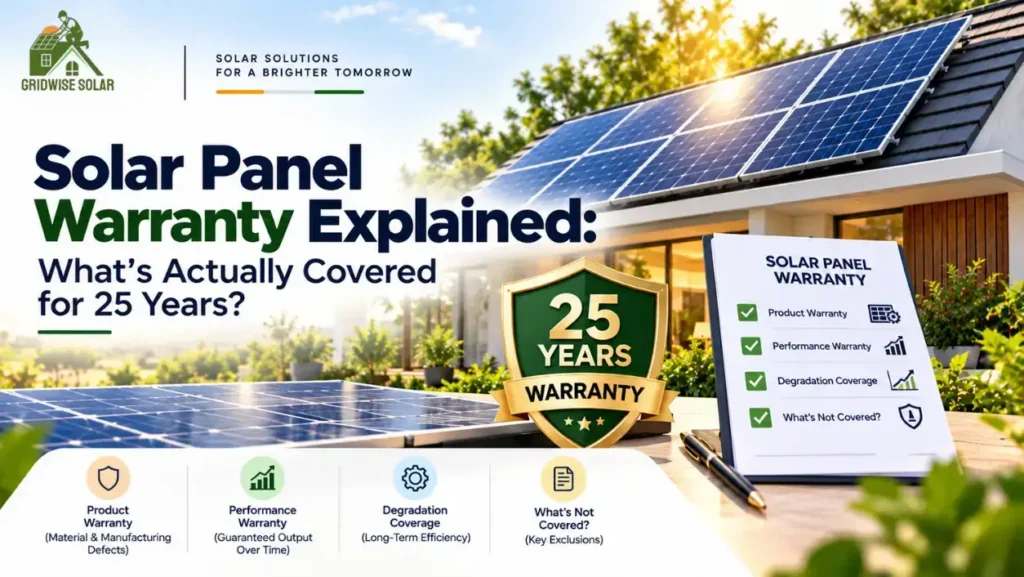
“25-year warranty” sounds pretty clear when you see it in a solar quotation. But not every part of the solar system is protected for the next 25 years. Typically, solar panels come with a product warranty and a performance warranty. The inverter warranty is separate. The mounting structure, electrical components, and installation work can have separate terms too.
Homeowners should consider a few basic details before selecting a solar company in Delhi NCR. What does the warranty include? Who will handle the claim? Which documents will be needed? Are labour, transport, or other costs included?
These points are easier to address before installation than after it’s been installed for several years.
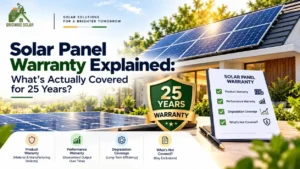
What Does a 25-Year Solar Panel Warranty Actually Mean?
Typically, two warranties cover a solar panel.
Product Warranty
The primary product warranty covers defects in the panel. During the warranty period, if a manufacturing or material defect occurs, the manufacturer agrees to provide coverage under the warranty’s terms and conditions.
Depending on the panel and manufacturer, this can include:
- Manufacturing defects
- Premature material failure
- Junction-box defects
- Abnormal delamination
- Defects in module materials or workmanship
- Other failures specifically defined in the manufacturer’s warranty document
Some premium modules now come with product warranties of up to 25 years. This doesn’t mean that all panels on the market offer the same warranty durations. Both the panel series and the manufacturer matter.
So, if you are comparing a solar company in Delhi, ask for the actual warranty document for the panel being offered. Don’t base your decision only on a salesperson saying the panel has a “25-year warranty.”
Performance Warranty Is Different
The performance warranty states the power the panel will provide as it ages.
Solar panels lose some efficiency over time. That is normal. A performance warranty sets a minimum output level that the manufacturer says the panel should maintain during the stated period.
Many current N-type TOPCon products come with performance warranties that run for around 30 years. Each product has a different degradation limit. Some current TOPCon warranties specify around 87% or more of the original rated output near year 30.
This matters for residential solar panels because the performance warranty can last longer than the product warranty.
Product Warranty vs Performance Warranty
The easiest way to separate the two is to look at what each one deals with:
| Warranty Type | What It Generally Covers |
| Product Warranty | Manufacturing defects and specified material/workmanship failures |
| Performance Warranty | Minimum guaranteed power-output level over time |
| Inverter Warranty | Covered separately by the inverter manufacturer |
| Installation Warranty | Workmanship-related issues covered by the installer according to its own terms |
A panel can still be working but produce less power than promised under its performance warranty. That differs from a physical defect in the panel.
For example, a panel with a manufacturing problem may fall under the product warranty. A panel that has degraded beyond the guaranteed level may involve the performance warranty instead.
A professional solar company in Noida should explain these two warranties separately before installing the system.
Does a 25-Year Warranty Cover Complete Panel Replacement?
Not always. If the manufacturer accepts a product warranty claim, the solution will depend on the warranty conditions. The company will either repair or replace the panel, or supply an equivalent panel, or offer other remedies as specified in the warranty.
There are also costs that homeowners should not assume are included:
- Removal of the old panel
- Installation labour
- Transportation
- Shipping
- Crane or access costs
- Replacement of unrelated components
- Loss of solar generation during downtime
The warranty may cover the panel but not the labour needed to remove and install it. The same can apply to transport or other expenses.
That is why you should check the actual warranty document. A “25-year warranty” printed in a brochure does not tell you every condition attached to a claim.
What Is Usually Not Covered by a Solar Panel Warranty?
Solar module warranties also have exclusions.
Exclusions vary by manufacturer. A claim can be refused if the damage happened because of something that the manufacturer does not cover.
Some examples are:
- Incorrect installation
- Unauthorized modifications
- Improper handling
- External physical damage
- Failure to follow installation instructions
- Damage from circumstances excluded in the manufacturer’s warranty
- Missing identification or documentation
- Use outside specified operating conditions
If you are using a solar company in Ghaziabad, make sure the installation follows the manufacturer’s requirements. A poor installation can create problems later if you need to make a warranty claim.
Always check the warranty for the exact panel. One manufacturer’s exclusions may not be the same as another manufacturer’s.
Does the Inverter Also Get a 25-Year Warranty?
Usually not.
The inverter comes with its own manufacturer warranty. Its coverage period can differ significantly from the warranty offered on the solar panels.
The warranty can depend on the inverter technology, brand, model, and whether the manufacturer offers an extended warranty.
This applies to systems that use:
- String inverters
- Hybrid inverters
- Microinverters
- Optimizer-based architectures
For example, Enphase microinverters have a warranty structure that is different from a conventional string inverter.
When comparing solar installation in Delhi NCR, ask for the panel warranty and inverter warranty separately. Don’t treat them as one 25-year warranty covering the complete system.
What About the Mounting Structure, Cables and Electrical Components?
The 25-year warranty on a solar panel does not automatically cover the other parts of the rooftop system.
A residential rooftop system can include:
- Solar panels
- Inverter
- Mounting structure
- DC cables
- AC cables
- Connectors
- ACDB/DCDB
- Earthing
- Surge protection
- Monitoring equipment
These parts can have separate warranties from their manufacturers or suppliers.
This is one reason solar installation quality matters. The best panel warranty does not solve wiring issues, structural issues, or insufficient electrical protection.
Before accepting a quote, ask for details on the specifications and warranties of the main components from the solar company in Faridabad.
What Is an Installation or Workmanship Warranty?
An installation warranty comes from the installer. It is different from the product warranty offered by the panel manufacturer.
This type of warranty generally deals with problems caused by the installation work.
Depending on the agreement, it may cover:
- Panel mounting
- Cable routing
- Electrical connections
- Installation-related workmanship
- System commissioning
The period and coverage can differ from one installer to another. Get these terms in writing before the work begins.
This is especially useful for residential solar installation. For example, if the panel has a manufacturing defect, the manufacturer may be responsible. If the problem happened because the panel was installed incorrectly, the installer warranty may apply instead.
The two warranties cover different types of problems.
Why Documentation Matters for a Warranty Claim
A warranty claim becomes much easier when you have records showing what was installed.
Homeowners should keep:
- Final invoice
- Solar panel make and model
- Panel serial numbers where provided
- Inverter details
- Warranty certificates
- Installation documents
- Commissioning records
- Installer contact information
Serial numbers can also be useful. Manufacturers may use panel barcodes or serial numbers to check product authenticity when processing a claim.
A reliable solar company in Gurgaon should hand over the project documents after installation. Keep them somewhere safe, rather than relying only on the payment receipt.
Does a Performance Warranty Guarantee Your Electricity Bill Savings?
No.
A performance warranty talks about the panel’s rated power output. It does not promise that your electricity bill will stay at a certain level.
The amount of electricity your rooftop system actually generates can change for several reasons:
- Shading
- Dirt
- Weather
- Temperature
- Inverter operation
- Grid conditions
- System downtime
- Panel orientation
- Maintenance
So, a 25- or 30-year performance warranty should not be read as a guarantee of a fixed electricity bill or a fixed amount of yearly savings.
Regular solar services in Delhi NCR, monitoring, and maintenance can help spot problems that reduce actual system generation.
What Should You Ask Before Finalising Your Solar System?
Before approving a rooftop solar quotation, ask the installer these questions:
- What is the exact solar panel model?
- How long is the product warranty?
- How long is the performance warranty?
- What output percentage is guaranteed at the end of the performance-warranty period?
- What is excluded?
- Who handles the warranty claim?
- Are labour and transportation included?
- What warranty applies to the inverter?
- What workmanship warranty does the installer provide?
- Will all warranty and installation documents be handed over after commissioning?
The answers can tell you much more about the system than simply seeing “25-year warranty” written in a quotation.
Conclusion
Every solar panel warranty is designed to safeguard your investment, but it’s important to understand what the coverage entails.
The product warranty generally deals with specified manufacturing or material defects. The performance warranty sets a minimum level of panel output over time. The inverter, mounting structure, electrical equipment, labour, and installation workmanship can all have separate warranty terms.
Gridwise Solar helps homeowners understand these details before installation, rather than treating the warranty period as just a number in a brochure. Our team plans TOPCon-based residential rooftop systems with quality components and explains the equipment selected for each project.
Gridwise Solar can help you compare solar panel specifications, explain warranty details, and even plan an entire rooftop solar power system with a focus on long-term reliability.
To get professional solar installation service in Delhi NCR, call Gridwise Solar to have your roof inspected and receive a solar system proposal.
FAQs
Does a 25-year solar panel warranty mean the panel will never fail?
No. The warranty specifies which issues the producer will address. It does not mean the panel cannot fail within those 25 years.
Is product warranty the same as performance warranty?
No. Product warranty generally covers manufacturing or material defects. A performance warranty covers the minimum rated output the panel should maintain over time.
Do TOPCon panels have a 25-year warranty?
Many modern TOPCon panels come with long product and performance warranties. This will vary according to the manufacturer and model, so refer to the warranty certificate of the panel you are purchasing.
Does solar panel warranty cover the inverter?
No. An inverter’s warranty will usually be from its own manufacturer. The period and terms vary by brand and model.
Is installation labour covered for 25 years?
Not necessarily. Labour and workmanship coverage depend on the warranty terms offered by the installer and manufacturer. Check this before approving the installation.
What documents should I keep after solar installation?
Maintain an invoice, panel and inverter information, available serial numbers, warranty documents, installation records, commissioning information and the installer’s name and contact details.