





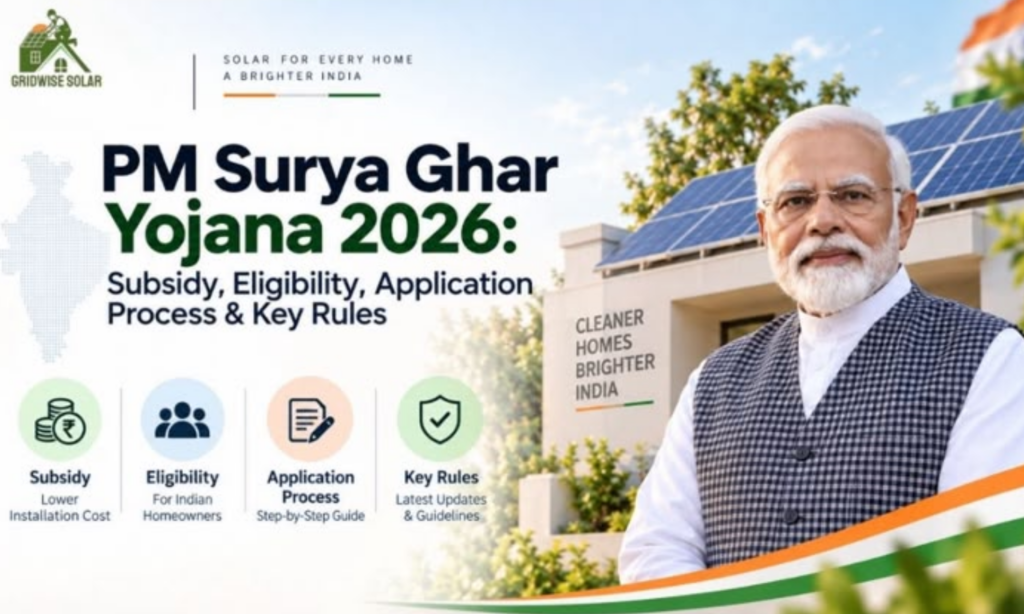
The Government of India’s residential rooftop solar program is called PM Surya Ghar: Muft Bijli Yojana, or PM Surya Ghar Yojana 2026. It provides Central Financial Assistance (CFA) to eligible residential customers who install rooftop PV systems.
As of September 2026, the scheme is still running. According to MNRE’s official guidelines, it will remain in force until 31 March 2027, with an approved outlay of ₹75,021 crore. It aims to enable rooftop solar installation in 1 crore residential households.
Actual savings will depend on the system size, power output, household consumption, and local billing policies.
According to MNRE, PM Surya Ghar Yojana 2026 aims to provide subsidised rooftop electricity through solar PV installations.
What Is PM Surya Ghar Muft Bijli Yojana?
PM Surya Ghar: Muft Bijli Yojana was launched on the National Portal on 13 February 2024 and then got approved by the Government of India on 29 February 2024. The Ministry of New and Renewable Energy (MNRE) operates it.
Its main aims are:
- Supporting rooftop solar installations for 1 crore residential households
- Helping households generate their own electricity
- Providing central financial assistance for eligible residential installations
- Expanding India’s residential rooftop solar capacity
- Creating a stronger rooftop-solar vendor, manufacturing, and service ecosystem
The PM Surya Ghar Yojana 2026 subsidy discussed here applies only to eligible residential grid-connected rooftop solar systems. Commercial and industrial consumers cannot claim this residential CFA.
PM Surya Ghar Yojana 2026 Subsidy Amount
In most states/UTs, the existing subsidy regime outlined by the MNRE would appear as follows:
| Rooftop Solar Capacity | Central Subsidy |
| 1 kW | ₹30,000 |
| 2 kW | ₹60,000 |
| 3 kW | ₹78,000 |
| Above 3 kW | Maximum central CFA remains ₹78,000 |
The way it is worked out is:
- First 2 kW: ₹30,000 per kW
- Next 1 kW: ₹18,000 per kW
- Capacity beyond 3 kW: No additional central CFA
For instance, the subsidy for a 6 kW residential installation remains at only ₹78,000 even though the remaining 3 kW of capacity is eligible for subsidy.
This matters for those considering larger 5 kW, 10 kW, or other residential systems, as the central subsidy does not exceed ₹78,000 for systems over 3 kW under normal CFA rules.
Who Is Eligible for PM Surya Ghar Yojana?
The CFA is meant for residential electricity consumers who install eligible grid-connected rooftop solar.
Under MNRE guidelines, applicants need a valid electricity consumer account number or similar consumer ID with the local distribution utility. The rooftop solar system must be linked to that residential electricity connection.
Eligible installations can cover systems put up on:
- Rooftops
- Terraces
- Elevated rooftop structures
- Certain Building Integrated Photovoltaic systems
- Eligible systems using approved group or virtual net-metering arrangements
Commercial and industrial consumers do not qualify for the residential CFA under this part of the scheme.
DCR Solar Panels Are Required for the Subsidy
This is one of the key rules every homeowner should know.
To get CFA under the PM Surya Ghar Yojana 2026, the solar modules must meet the Domestic Content Requirement (DCR). MNRE says the modules must be made in India using solar cells also made in India.
If non-DCR modules are used in a system that claims the subsidy, that system becomes ineligible for CFA under the normal scheme rules.
So anyone planning to claim the PM Surya Ghar Yojana 2026 subsidy should check that the proposed panels meet the DCR rules before the installation starts.
How to Apply for PM Surya Ghar Yojana 2026?
Applications go through the official PM Surya Ghar National Portal. The guidelines say eligible consumers must apply on the National Portal and use a vendor registered there to get the benefits.
The usual steps are:
- Register on the PM Surya Ghar National Portal using the required consumer and electricity-connection details.
- Submit the rooftop solar application for the relevant residential connection.
- Choose a vendor registered on the National Portal.
- Finalise system design, components, and commercial terms with the selected vendor.
- Install the rooftop solar system according to the applicable technical requirements.
- Update installation details on the portal, including the documents and geo-tagged photographs required by the scheme.
- DISCOM inspection and metering process take place according to applicable regulations.
- CFA processing begins after the DISCOM successfully verifies and approves the installation.
MNRE’s guidelines also say consumers are free to negotiate system design, components, quality and financial terms with a registered vendor.
Is Technical Feasibility Approval Required?
The MNRE operational guidelines state that rooftop solar application of up to 10kW is counted as approved without a separate technical-feasibility approval process, provided that the State Regulatory Commissions and DISCOMS implement this.
The same guidelines note that until this rule is implemented locally, consumers may still have to submit papers for feasibility approval if existing state rules require it.
That is why homeowners should check the exact process followed by their local DISCOM instead of assuming the steps are the same all over India.
Can Housing Societies and RWAs Receive Subsidy?
Yes. Eligible Group Housing Societies and Residential Welfare Associations can get CFA for rooftop solar that serves common facilities.
The guidelines offer CFA of ₹18,000 per kW for these common-facility systems, with limits of up to 500 kWp and the applicable per-household capacity calculation. The connection must serve common facilities and not supply power straight to individual flats.
Important Things to Verify Before Applying
Because the subsidy depends on meeting the rules, homeowners should check these points before they install anything:
- The electricity connection is eligible under the residential category
- The application is made through the official National Portal
- The selected vendor is registered on the portal
- The solar panels meet applicable DCR requirements
- The proposed installation meets MNRE’s minimum technical specifications
- System and consumer details match the application
- Required DISCOM inspection and metering procedures are completed
Do not start an installation only because someone said the subsidy is sure to come. CFA is released only after the scheme conditions are met and the portal and DISCOM verification steps are complete.
Conclusion
PM Surya Ghar Yojana 2026 makes residential rooftop solar more affordable by providing central financial assistance to eligible households. For most states and UTs, the standard subsidy is ₹30,000 per kW for the first 2 kW and ₹18,000 for the next 1 kW, capped at ₹78,000 for systems of 3 kW or more.
To qualify, homeowners must follow the official steps carefully: residential eligibility, National Portal registration, using DCR-compliant modules, choosing a registered vendor, and completing DISCOM verification and metering.
Gridwise Solar helps homeowners understand the solar installation process, choose the right system capacity, plan TOPCon-based rooftop systems, and handle the paperwork and approvals needed for eligible projects.
If you are planning residential solar and need help with system design, installation, and the PM Surya Ghar process, contact Gridwise Solar for a rooftop assessment and a customised solar proposal based on your home’s electricity needs.