



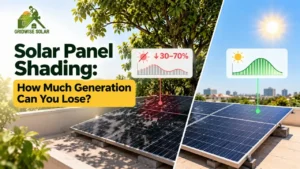

Solar Panel Shading can significantly reduce your electricity production, much more than you realise. The loss depends on the inverter type, the extent of shading, how long it lasts, where on the panel the shading occurs, and the panel wiring configuration.
Before installing the panels, a professional solar company in Delhi NCR should assess whether the area is shaded. Shadows from water tanks, staircase rooms, parapet walls, nearby buildings, trees, poles, and rooftop equipment can shift throughout the day.
If you understand how shade affects solar panels before the install, you avoid unnecessary generation losses. You also make better use of your roof.
What Happens When Shade Falls on a Solar Panel?
Solar panels produce electricity when sunlight strikes their cells. When a module is shaded, the shaded parts receive less sun and produce less current.
The solar panel shadow loss depends on more than how much of the panel is covered. A small shadow can sometimes cut a larger share of the output because the cells inside the module are wired together.
If you’re comparing a solar company in Delhi, remember this. Panel layout should follow the sunlight. Fitting as many modules as possible on the terrace shouldn’t be the goal.
How Much Generation Can Solar Panel Shading Reduce?
No single number works for every roof.
The impact of solar panel shading depends on:
- How much of the panel is shaded
- How long the shading lasts
- Which cells are affected
- Number of panels affected
- String configuration
- Panel orientation
- Inverter technology
- Bypass-diode behaviour
A short morning shadow might barely affect your daily output. A water tank that shades a few modules during strong midday sun can cost you much more.
So solar installation in Delhi NCR should include a proper shade check. Measuring the roof isn’t enough.
Partial Shade Can Matter More Than It Looks
Many people think that if 10% of a panel is covered, the output drops by 10%.
It doesn’t always work that way.
Most solar modules are split into groups of wired-together cells. If a shadow falls on part of one group, bypass diodes may switch on. They protect the module and let current flow around the shaded part.
That helps. Some of the panel’s output can still be lost, though.
A solar company in Noida should check where the shadow lands on the module. Seeing how much of the roof looks shaded doesn’t tell you enough.
Why String Inverter Systems Can Be More Sensitive to Uneven Shading
In a regular string inverter setup, several panels are wired together in a string.
The panels in a string affect each other. If one module gets very different conditions, the whole group can suffer. It depends on the design and the panel electronics.
That doesn’t mean string inverters are a bad choice for shaded roofs. Good string design, multiple MPPT inputs, smart panel grouping, and avoiding heavily shaded spots all make a big difference.
For a professional solar installation Gurgaon, choose the inverter setup after you understand the shade pattern and the roof direction.
Can Microinverters Help With Solar Panel Shading?
Microinverters work another way.
Each panel runs with its own microinverter. You don’t connect several panels to one central inverter. So one module’s performance is handled separately from the panels next to it.
On the right property, this can reduce the wider damage from uneven solar panel performance in shade. One shaded module doesn’t pull down the whole string.
A solar company in Gurgaon may suggest Enphase microinverters for premium home projects with tricky roof directions or changing shade. They don’t make shade go away, though. A shaded panel still gets less sun and makes less power.
Common Sources of Rooftop Shading
Most shade problems come from things that are permanently on the roof. Trees are less often the cause.
Common sources:
- Water tanks
- Staircase rooms
- Parapet walls
- AC outdoor units
- Solar water heaters
- Satellite dishes
- Nearby buildings
- Trees and branches
- Utility poles
- Elevated rooftop structures
When considering rooftop shading solar projects, keep in mind that the sun moves as it goes through the day and changes with the seasons as well. A solar company in Ghaziabad should consider how shadows move. One photo taken at one time of day won’t show that.
Morning and Evening Shade vs Midday Shade
Not every hour of sun adds the same amount to your daily generation.
Shade early in the morning or late in the evening costs you less, because the sunlight is weaker then.
Shade during the strongest hours costs more. Your panels could be producing much more power at that time. So judge solar panel shading by when it happens and how big it is.
A good solar company in Faridabad should determine whether shadows only touch the array briefly or cover large sections during peak hours.
How Can Shading Be Reduced During Solar Design?
The best way to handle shade is to avoid it before installing the panels. Good design can include:
- Moving panels away from water tanks
- Leaving clearance from staircase rooms
- Adjusting panel rows
- Using different rooftop sections
- Raising panels where appropriate
- Separating arrays with different orientations
- Using suitable MPPT configuration
- Considering panel-level electronics where justified
Professional solar services in Delhi NCR should start with roof planning. Don’t decide the number of panels first.
A smaller array in the right spots can work better than one with extra panels crammed into shaded areas.
Does Cleaning Solve Solar Panel Shading?
Cleaning and shading are two different problems. Dust and dirt reduce the sunlight that reaches the panel’s cells. A shadow blocks direct sunlight because something outside the panel blocks it.
Cleaning the panels won’t fix shade from a water tank, a wall, a tree, or the building next door.
Both lower generation, so homeowners often mix them up.
A reliable residential solar company Gurgaon should help you figure out if low output comes from dirt, shade, system setup, or something else.
Can Trees Be Trimmed to Improve Solar Generation?
Sometimes. It depends on the property and the tree. If branches cause heavy shade during certain seasons, pruning may help, as long as it’s legal and practical.
Still, don’t assume every tree has to go because you’re getting solar. Look at the shadow pattern first. Then check if moving the panels or changing the layout fixes it.
On a rooftop solar installation Noida project, careful layout planning can often keep the surroundings and the solar panels from getting in each other’s way.
Can Solar Panels Still Work in Shade?
Yes. A shaded panel doesn’t always stop making power. Diffuse sunlight still reaches the module, and partially shaded sections can keep producing power. Output is usually lower than in direct sun. So don’t think of solar panel shading as all-or-nothing.
System design should cut avoidable shade. The key to shade is preventing it before the panels are installed. It also shouldn’t let one misplaced panel ruin an entire group.
How to Check Whether Shading Is Affecting an Existing System
If you can monitor, check for patterns in your daily generation. Things to watch for:
- Repeated dips at similar times
- One panel or section underperforming
- Seasonal reduction beyond expected weather changes
- Generation improving after an obstacle is removed
Panel-level monitoring makes these patterns easier to catch on systems built with the right electronics.
Walking the roof and looking can also be helpful. Look for new trees growing in the shade, new equipment on the roof, or nearby construction.
Conclusion
Solar panel shading can reduce the returns from your rooftop investment. Choosing the right installation partner helps you address shading risks early and build a system designed around your roof’s actual generation potential.
Gridwise Solar assesses roof obstacles, moving shadows and available space before finalising your installation. From panel orientation and string design to MPPT configuration and inverter selection, we plan your system to make productive use of your rooftop.
Our home rooftop solutions feature high-efficiency TOPCon panels. For suitable premium projects, we can also consider Enphase microinverters where panel-level operation offers a practical advantage in managing shading.
Get more from your roof with Gridwise Solar. Contact our team today for a rooftop assessment and a solar installation plan that prioritises usable generation, long-term performance and value for your investment.