




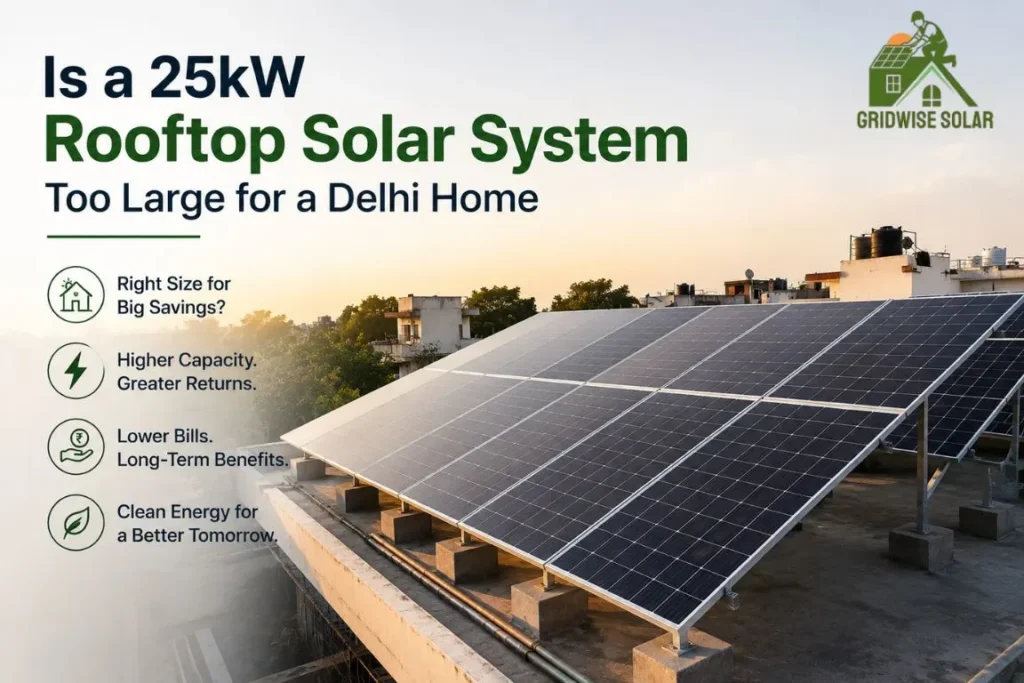
A 25kW rooftop solar Delhi setup might seem oversized for a regular house at first glance. Yet for certain Delhi properties, it fits just fine. Big villas, multi-story houses, joint family homes, and places running several air conditioners, high-end gadgets, work-from-home setups, EV chargers, lifts, pumps, and other heavy equipment often pull far more power than an average home.
So the real question isn’t whether 25kW looks too big. Check if your power use, free roof space, sanctioned load, wiring setup, and plans for later years actually call for this size.
Putting in extra panels just because the roof has room is poor planning. Get a proper check of the house by scheduling a site audit by a rooftop solar installation company in Delhi and power pattern before you even think about 25kW rooftop solar Delhi.
Who Actually Needs a 25kW rooftop solar Delhi at Home?
A 25kW rooftop solar Delhi is not meant for every family. If a smaller system covers your power needs, there is no need to go much bigger.
Still, Delhi has plenty of big independent houses and villas that use a lot of electricity.
A 25kW rooftop solar Delhi system can be worth looking at for:
- Large independent villas
- Multi-floor family homes
- Joint-family residences
- Homes with multiple air conditioners
- Properties with lifts and water pumps
- Homes with EV charging requirements
- Residences with extensive automation and security systems
- Properties with significant daytime electricity consumption
Gridwise Solar, the best 25KW rooftop solar company in Delhi NCR, does not call a system large just by the number. They check if the size matches the house properly.
7 Things to Check Before Installing 25kW Rooftop Solar in Delhi
A 25kW home setup needs more thought than just finding space for panels. Look at these seven points first.
1. Your Actual Electricity Consumption
Begin with your power bills. A big house does not always need 25kW solar. Two villas of the same size can use very different amounts of power based on how many people live there, how much the air conditioners run, what gadgets you have, daily habits, and how much power you need in daylight hours.
Looking at old bills shows the real usage pattern before anyone suggests a system size. If the figures point to 10kW as a better match, installing 25kW only because it sounds stronger isn’t smart.
2. Available Shadow-Free Rooftop Space
A 25kW rooftop solar Delhi system needs a good amount of clear roof area. As a rough starting figure, you may need about 1,500–2,500 sq. ft. The exact space depends on panel power, size, mounting direction, gaps between them, and the roof shape.
Total terrace size is not the same as usable solar space. Water tanks, staircases, utility spots, parapet walls, outdoor gear and walkways cut down the room for panels. Shade from nearby buildings can shrink the useful area even more.
A proper roof solar site survey in Delhi should confirm the real free space before anyone designs the system.
3. Shading Across a Larger Panel Array
Shade matters more as the panel set grows. A 25kW system often spreads across different parts of the roof instead of one clean patch. Some parts may get different amounts of sun during the day. Nearby buildings, trees, water tanks, staircases, walls, and other roof items all need checking when placing the panels.
If the roof faces different directions or has unavoidable shade, Gridwise Solar can consider other inverter setups, including Enphase microinverters, for the right premium home projects.
4. Structural Condition of the Rooftop
A system that should last decades needs a solid base. Before fitting a large home array, check the roof type, its present state, free mounting spots, any planned building work and waterproofing needs.
The mounting frame also needs close attention. Do not treat it as a small extra for the panels. Frame design, material strength, fixing method, height, wind load and how well it is fitted all affect how long the whole rooftop setup stays sound.
5. Your Home’s Electrical Infrastructure
A 25kW system has to link properly with the house wiring already in place. The site check should cover inverter placement, distribution boards, cable paths, safety gear, earthing, connection spots and other fitting needs.
This becomes more important in bigger homes that already run complex wiring for different floors, heavy appliances, lifts, pumps, EV chargers or other loads. Solar planning and electrical planning should go together. Do not treat the roof panels as a stand-alone job.
6. Your Future Electricity Requirements
A system should match more than what the house uses now. Think about how the property might change in the next few years. Will you buy an EV? Add more air conditioners? Put in a lift? Expand the home office gear? Build another floor? Add more automation?
You can factor future use into planning when it makes sense. But preparing for later does not mean simply making the system bigger than needed. It means talking about realistic changes with the installer so they can build them into the design and size suggestion.
7. Whether 25kW Is Better Than a Smaller System
This may be the key question. Do not start by saying “I want 25kW.” Start with “What solar size actually suits my home?” A good installer should be ready to suggest 10kW when 10kW is the right fit, even if the roof could hold 25kW.
Similarly, if your power use and home conditions truly support a bigger setup, a 25kW system can be planned. The goal is not the biggest possible system. It is the right size for the job.
10kW vs 25kW Solar: Which Is Better for a Large Delhi Home?
For big homes the 10kW versus 25kW choice should start with power use, not the system size.
A 10kW System May Make Sense When:
The house uses a fair amount of power but still fits well with a 10kW system, and later use is not expected to jump a lot.
A 25kW System May Make Sense When:
The property uses much more power, has enough clear roof space, has the right electrical setup and has a usage pattern that supports the extra size.
The gap between the two systems is big, so homeowners shouldn’t jump straight from a smaller home system to 25kW without a proper check.
How Should a 25kW Residential Solar System Be Designed?
Large home systems gain a lot from custom planning. Instead of just placing panels wherever they fit, treat the whole roof as one complete setup.
Panel Layout
Place panels according to sun access, shade, roof shape, direction, obstacles and space for later upkeep.
Inverter Architecture
Choose the inverter setup based on what the system needs, not just whatever unit is on hand.
Mounting Structure
The frame must match the roof, panel layout, site conditions and long-term needs.
Electrical Protection
Good cables, proper AC/DC safety gear, earthing, connectors and clean electrical linking form part of the system, not extras.
Monitoring
Monitoring lets you see the generation and spot any drop in performance that needs a look. For higher-end projects where panel-level checks and more flexible layout help, Enphase microinverters can also be checked against the roof conditions.
Is 25kW Solar Suitable for Delhi’s Large Villas?
It can be. Delhi has several areas with bigger independent houses and villas where power use and roof space can support higher-capacity solar systems. Homes with lots of air conditioning, several floors, bigger families, home offices, EVs, pumps, lifts and high-end electrical gear often have very different power patterns from regular houses.
But the choice must still rest on the specific property. A large villa does not automatically need a large solar system, just as a smaller-looking house should not be assumed to use little power. That is why Gridwise Solar begins with power use and site conditions before suggesting any size.
Why Choose Gridwise Solar for a 25kW Rooftop Solar System in Delhi?
A 25kW home project is a big long-term job. Gridwise Solar is a leading residential solar installation company in Delhi that handles these with attention to system planning, part quality, clean work, and the homeowner’s real needs.
Detailed Site Assessment
At Gridwise Solar, our team of solar installers check power use, free roof area, shade, existing structures, electrical setup, and future power needs before locking in the size.
Customized System Design
We plan the panel layout and overall setup around your house, not a standard home package.
Quality Components
Gridwise Solar chooses solid panels, reliable inverter options, strong mounting frames, branded cables, and the right electrical safety gear.
Premium Inverter Options
Enphase microinverters can be considered for suitable premium home projects where panel-level monitoring and flexible design give real value.
Professional Installation
From mounting and cable paths to electrical linking, earthing, testing, and start-up, we take care with every step.
End-to-End Support
Gridwise Solar stays with the job from the first talk and site check through planning, fitting, start-up, and post-installation support.
Conclusion
So, is a 25kW system too large for a Delhi home? For many houses, yes. For the right large home property, not always. A 25kW rooftop solar Delhi system can work when high power use, enough clear roof space, the right electrical setup, and future power needs all support that size.
The mistake is choosing 25kW before assessing the home. Looking for a solar company in Delhi for site survey? Gridwise Solar is your go-to solar company in Delhi that looks at the home first and suggests the system second, so homeowners invest in the size and technology that truly match their needs.
Thinking about 25kW solar for your Delhi home? Reach out to Gridwise Solar for site survey and a system plan built around your property.